
Bathrooms · 6 min read
Perth's Ageing In Place, Accessibility Experts - Servicing all of Perth
Bathrooms
2 April 2026 · 7 min read
AI overview
Bathroom floor slip resistance in Australia is measured by two standards: the R-rating for shod (footwear) use and the P-classification (P3 to P5) for barefoot wet areas. P4 is the minimum for any wet area where people walk barefoot, and P5 is the recommended standard for shower floors and wet rooms. Choosing the right tile and grout, and achieving the correct floor gradient, are the three things that separate a safe bathroom floor from a fall risk.
Key highlights
Summarise with AI
Ask an AI assistant to summarise this article and tell you how AccessAble can help with your home.
Australia uses two classification systems for tile slip resistance, both defined in AS 4586. The R-rating (R9 to R13) applies to surfaces walked in shoes or in conditions where footwear is expected. The P-classification (P3 to P5) applies to wet barefoot areas - which covers shower floors, wet room floors, and any bathroom floor that is regularly wet.
For bathroom floors in residential settings, the relevant rating is the P-classification. A smooth polished tile might carry an R10 or R11 rating for shod use but a P3 rating for barefoot wet conditions - meaning it passes for a kitchen floor but fails as a shower floor.
P3 is the minimum for a wet area where footwear is sometimes worn. P4 is the minimum for any wet area where people walk barefoot. P5 is recommended for shower floors, wet rooms and any bathroom used by people with reduced mobility or balance. This is a higher standard than many standard bathroom tiles meet.
P ratings are tested on an inclined ramp with a lubricant (oil or water depending on the test). A tester walks up and down the ramp barefoot until slipping; the angle at which slipping occurs determines the rating. Higher numbers mean better wet grip.
The surface texture of a tile determines its P-rating. Smooth, high-gloss polished tiles typically achieve P3 at best when wet - they look clean and bright, but they are genuinely dangerous underfoot when the floor is wet.
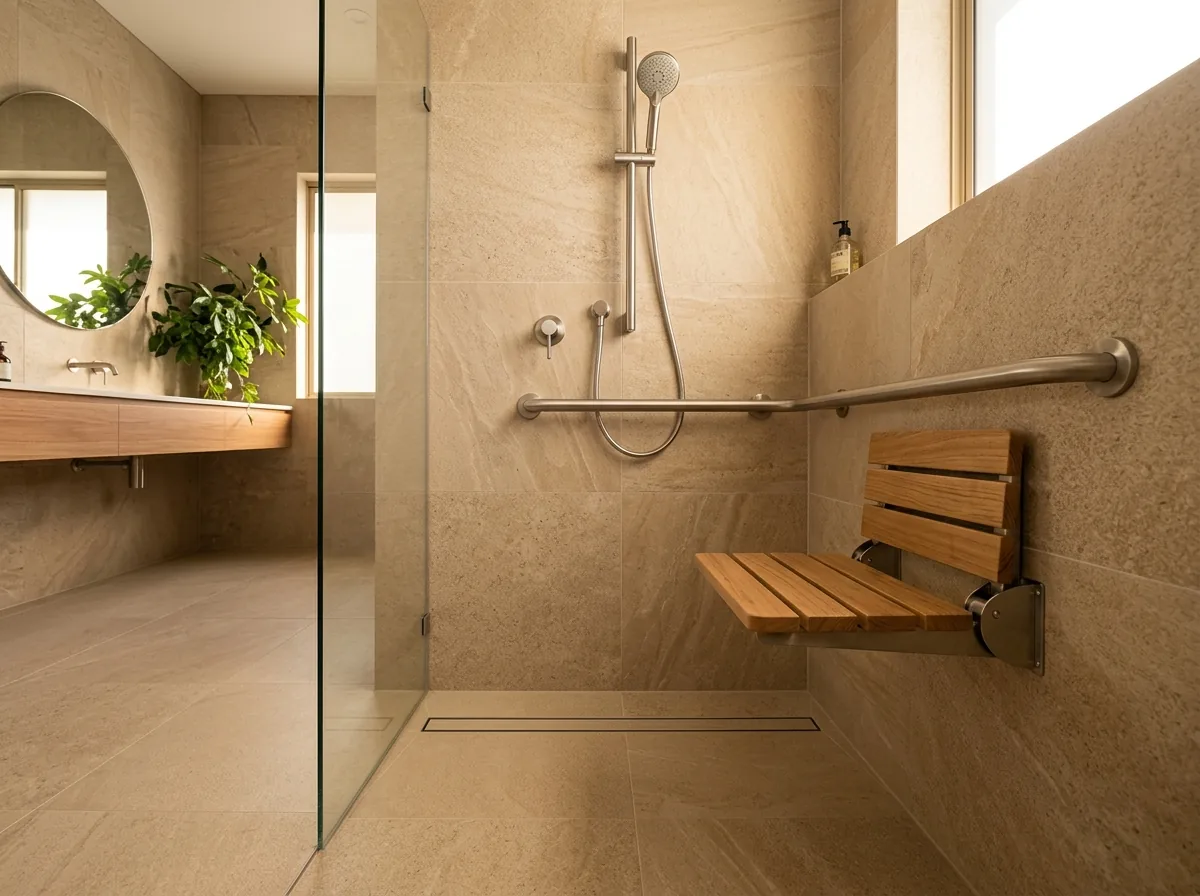
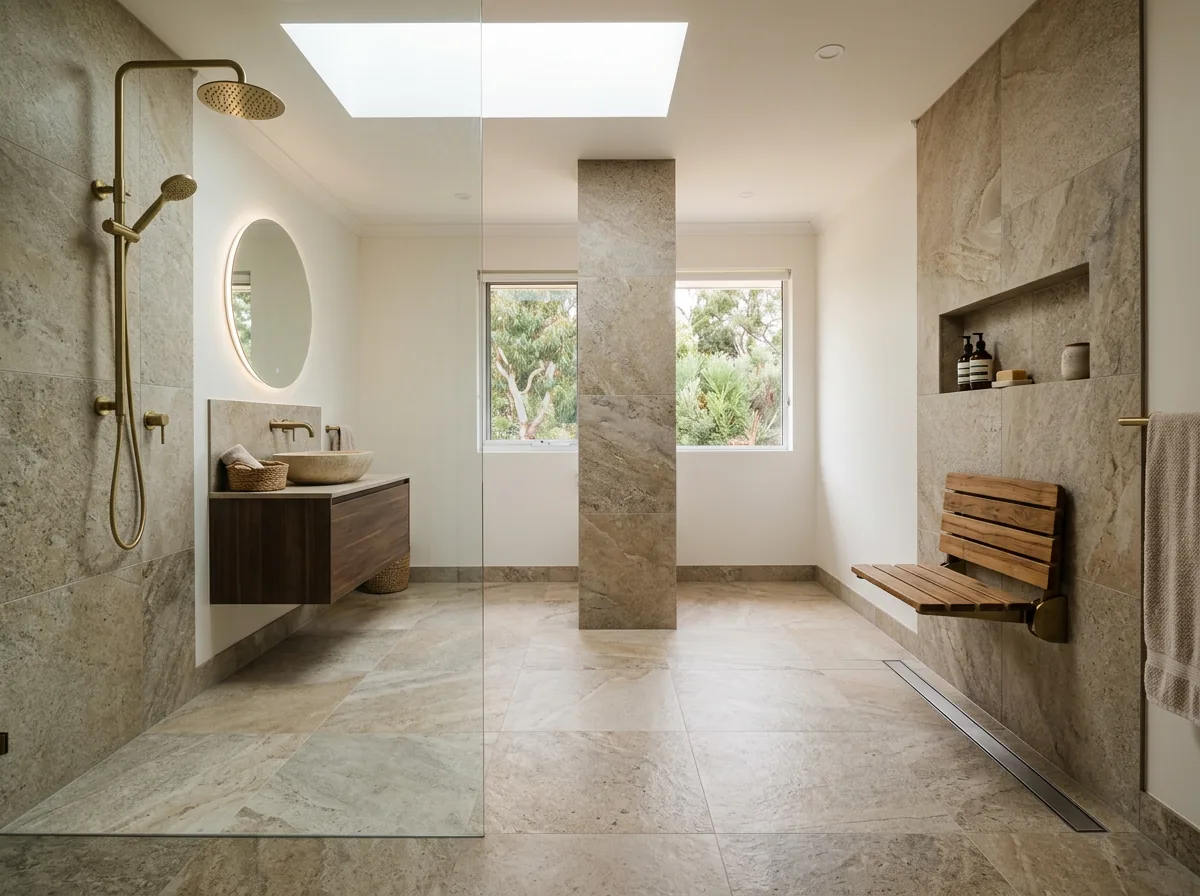
Textured, matte and structured surface tiles achieve P4 or P5. The texture traps water films and allows the foot to grip the tile surface. Common examples include textured slate-look porcelain, stone-look tiles with natural surface variation, and dedicated anti-slip ceramic tiles with a fine surface relief.
Mosaic tiles - small tiles with frequent grout joints - perform well in wet conditions even with a relatively smooth tile surface, because the grout joints themselves provide grip and drainage. This is why mosaic is still a common specification for shower floors even in modern bathrooms.
Grout contributes to slip resistance, drainage and hygiene. Narrow grout joints (less than 3 mm) reduce the drainage channels in the floor surface; wide joints (6 mm or more) improve drainage but are harder to keep clean in a wet environment.
Epoxy grout is more resistant to staining, mould and chemical cleaners than cement-based grout, but it is harder to apply and costs more. For a wet room or accessible bathroom floor that will see heavy use and frequent cleaning, epoxy grout is worth the investment.
Grout colour matters too. A grout that closely matches the tile colour makes the floor look cleaner longer (staining is less visible) but reduces visual definition between tiles, which can affect orientation for people with low vision. A mid-tone grout that contrasts with the tile gives better visual definition.
No floor tile is slip-resistant if water pools on the surface. The floor must be graded to direct water to the drain. Australian Standard AS 3740 requires a minimum 1:80 gradient in a wet area; a 1:60 gradient is more effective in practice and is recommended for accessible bathrooms and wet rooms.
A 1:60 gradient means a 10 mm drop for every 600 mm of floor run. In a 1,200 mm wide shower zone, that is a 20 mm difference between the highest and lowest point. This is enough to drain effectively but gentle enough to walk on without feeling the slope underfoot.
In a wet room where the gradient must extend across the whole bathroom floor, the drain position matters. A central drain requires the floor to slope from all four walls; a linear channel drain along one wall simplifies the gradient to a single direction. Both work; linear drains are generally easier to achieve on a tight budget.
Slip resistance is about the floor surface. But for people with low vision, the contrast between floor and wall surfaces is just as important as grip - if you cannot see where the floor ends and the wall begins, navigation in a wet environment becomes difficult.
AS 1428 recommends a minimum 30 percent luminance contrast between floor and wall surfaces in accessible spaces. In practice, this means avoiding pale floor tiles against pale wall tiles. A warm mid-tone floor against a lighter wall, or a darker floor against a lighter wall, provides adequate definition.
The contrast between the toilet pan and the surrounding floor also matters. A white toilet on a white floor is hard to locate for someone with macular degeneration or other low-vision conditions. A coloured toilet mat or a contrasting floor tile in that zone is a simple fix.
If full retiling is not in the budget, a non-slip coating applied to existing tiles can raise their P-rating by one to two levels. The coating is a chemical treatment that etches the tile surface to increase grip. It costs approximately $50 per square metre for a professional application, or around $1,000 for a bathroom.
The treatment is invisible when dry and does not change the look of the tile. It does, however, reduce in effectiveness over time with heavy use of alkaline cleaners (bleach-based products). Annual retreatment may be needed in high-use bathrooms.
It is a practical short-term solution or a temporary measure while a full renovation is being planned. It does not address floor gradient, grout condition, or the layout of the shower - those still need a structural approach.
Related services
For a residential bathroom floor used barefoot, you need a minimum P4 rating under AS 4586. For a shower floor or wet room, P5 is recommended. Smooth polished tiles often achieve only P3 in wet conditions and are not suitable for accessible shower floors regardless of how they perform when dry.
Check the tile specification sheet for the AS 4586 P-rating. If you cannot find the rating, a non-slip testing kit or a professional assessment will confirm what you have. As a practical guide: if the tiles feel slippery when you step onto them with wet feet, they are likely P3 or below.
Australian Standard AS 3740 requires a minimum 1:80 gradient to the drain in a wet area. In practice, 1:60 is recommended for accessible bathrooms and wet rooms to prevent pooling. That translates to a 10 mm fall for every 600 mm of floor run.
They are a practical short-term measure that raises the slip resistance of smooth tiles by one to two P-rating levels. A bathroom is approximately $1,000, and larger floors are approximately $50 per square metre. The effect reduces with alkaline cleaners over time. For a permanent fix, tiles with the correct rating from the start are better.
Small mosaic tiles have frequent grout joints that act as drainage channels and grip points underfoot. Even a relatively smooth mosaic tile achieves a higher effective P-rating in a shower than a large smooth tile, because the joints prevent a continuous water film from forming across the surface.
AS 1428 recommends a minimum 30 percent luminance contrast between floor and wall in accessible spaces. In practical terms, avoid pale floor tiles against pale walls - use a mid-tone or darker floor against lighter walls to provide a clear visual edge between the two surfaces.
Filed under Bathrooms
Keep reading
Bathrooms · 6 min read
Bathrooms · 7 min read
Bathrooms · 14 min read
Next step
Ask us for a quote. We will tell you what we would change first in your home - and what it costs. AccessAble designs and builds in-house, so there is no waiting on a third party.
Monday to Friday, 7:00am - 5:00pm. Based in Melville, working right across Perth.