
Bathrooms · 7 min read
Perth's Ageing In Place, Accessibility Experts - Servicing all of Perth
Bathrooms
21 April 2026 · 6 min read
AI overview
Falls in the shower are one of the most common serious injuries for older Australians, and most of them are preventable. The combination of a level-entry floor, correctly positioned grab rails and a fold-down shower seat addresses the three highest-risk moments: entering, washing and exiting. Each of these changes can be done independently; together they make the shower substantially safer.
Key highlights
Summarise with AI
Ask an AI assistant to summarise this article and tell you how AccessAble can help with your home.
The shower combines wet surfaces, soap residue, steam that reduces visibility, and the physical demands of balancing on one leg while washing. For anyone with reduced strength, balance difficulty or a condition that affects coordination, those factors add up to a genuine fall risk.
Entry and exit are the highest-risk moments. Stepping over a shower hob - especially on exit, when the floor is wet and the person is fatigued - accounts for a large proportion of bathroom falls. Once inside the shower, reaching for the showerhead, turning to soap the back and bending to wash the feet are all movements that require balance and range of motion.
The good news is that the changes that address these risks are well established, relatively straightforward, and do not require a full bathroom renovation in most cases.
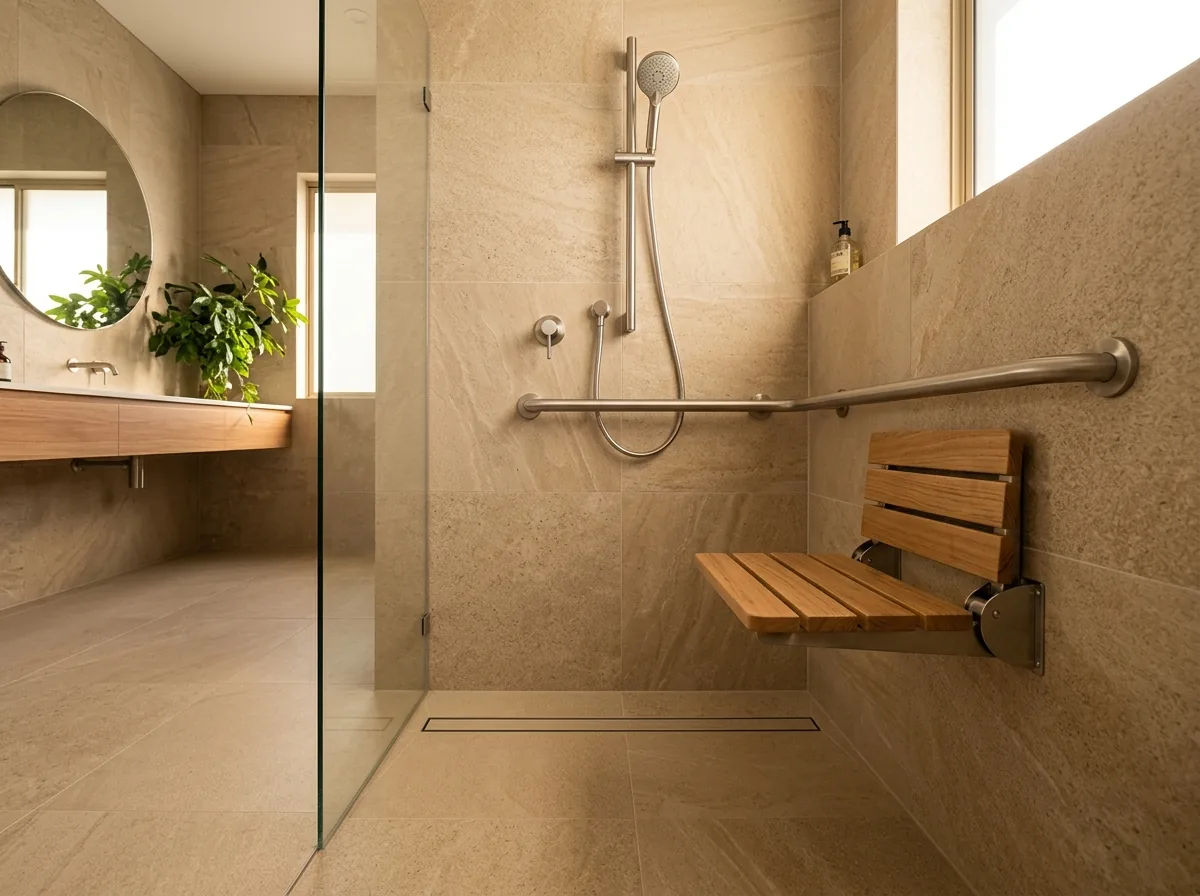
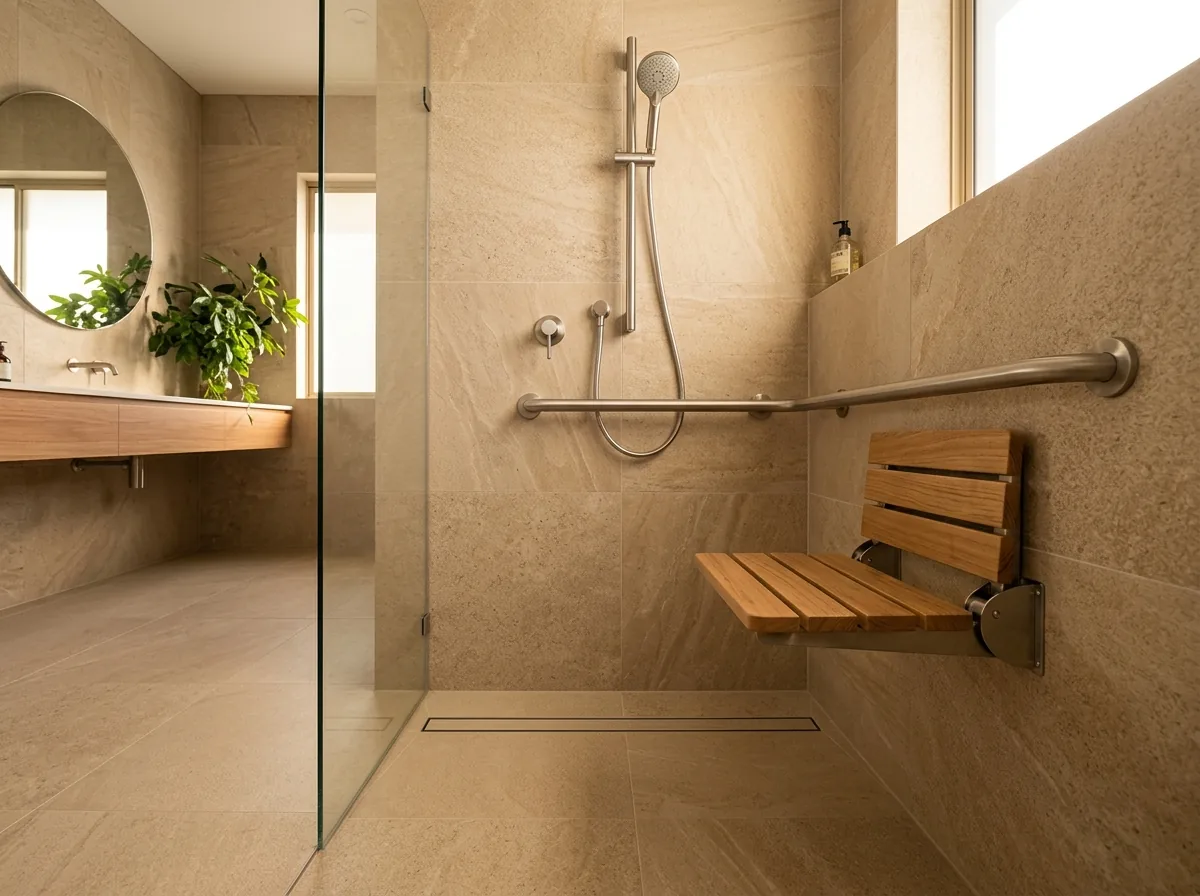
The shower hob - the raised step or lip at the entry - is the most common fall point. Removing it and creating a level entry eliminates the need to step over anything on entry and exit. This is a structural change that starts at $12,000, quoted as a bathroom job, but it is the single most effective improvement for anyone who has difficulty with the step.
If a full conversion is not immediately possible, a rubber or aluminium shower ramp ($80 to $250) can reduce the effective height of the hob to make it easier to step over. This does not eliminate the risk but reduces it in the short term.
A level-entry shower also allows the use of a shower chair or wheelchair without any lifting. The floor must slope correctly to the drain - a minimum 1:80 gradient, though 1:60 is better practice - and the waterproofing must extend across the full shower zone.
Grab rails provide the steadying points that prevent a slip from becoming a fall. The positions that matter most are: a horizontal rail at 840 to 900 mm on the entry wall (to hold while stepping in and out), a vertical rail at 900 mm on the side wall (to steady during washing), and a rail near the floor if seated showering is planned.
Rails must be fixed into wall studs or purpose-installed backing boards. A rail fixed only into tiles and plasterboard will pull out under load. If the wall substrate is inadequate, a backer board is installed behind the tiles before the rail is fixed - this is part of a proper accessible bathroom installation.
Standard rail diameter is 32 mm. The rail should extend far enough to allow a good grip through the full range of movement - a 600 mm horizontal rail at the entry, and a 900 mm vertical rail on the side wall, cover most users. Rail positioning should be checked against the actual height and reach of the person who will use it.
A fold-down shower seat allows the person to sit while showering without needing to bring in a portable shower chair each time. When not in use, it folds flat against the wall and takes up no floor space.
Seats are available in timber, teak, plastic and stainless steel. The seat should be fixed at 450 to 480 mm from the floor - the same height as an accessible toilet - so that transfer from a wheelchair or shower chair is at the same height. Load ratings vary; a standard fold-down seat is rated to 100 to 150 kg.
Sitting down to shower reduces the balance demands of the activity significantly. Washing the feet, rinsing shampoo and managing soap all become more stable seated. For anyone who fatigues quickly or has balance difficulty, the seat is worth fitting even if it will only be used occasionally.
A fixed shower rose requires the person to move their body to wet and rinse - arms up, head back, turning in place. A hand-held hose eliminates most of that movement. The hose comes to the person rather than the person reaching for the water.
A riser rail (a vertical bar that the hose cradle slides up and down on) allows the height to be adjusted to suit the user, whether sitting or standing. The combination of hand-held hose plus riser rail costs $280 to $550 installed and is compatible with most existing showerhead connections.
For anyone who showers seated, a hand-held hose is essential rather than optional - directing water to all parts of the body without getting up is not achievable with a fixed rose.
A standard shower mixer allows water temperature to vary as other taps in the house are used - a toilet flushing or a washing machine filling can cause a sudden change in pressure and temperature. For someone with reduced skin sensitivity (common in diabetes and some neurological conditions), a scalding temperature change may not be felt before damage occurs.
A thermostatic mixer maintains a pre-set temperature regardless of pressure changes. Once set to 38 degrees Celsius, the temperature stays at 38 degrees. The hot water cannot exceed the set point.
Perth's mains water temperature in summer is high enough that a standard shower can deliver water above 60 degrees Celsius. A thermostatic mixer with a 38-degree limit is a meaningful safety measure for anyone with reduced skin sensitivity, and provides a consistent, comfortable shower temperature for everyone else.
Smooth, polished floor tiles often achieve only a P3 rating when wet - meaning they provide minimal grip underfoot on a wet shower floor. Replacing them with tiles rated P5 - textured, matte-surface or structured porcelain - removes the underfoot slip risk that remains even after all other improvements are made.
If full retiling is not practical, a non-slip coating treatment (approximately $50 per square metre) can raise the effective slip resistance of existing tiles by one to two P-rating levels. The treatment is invisible, does not change the look of the tiles, and can be done in a single day.
The floor gradient to the drain also matters. If water pools on the floor rather than running to the drain, the pooled water is a slip risk regardless of the tile rating. A minimum 1:60 gradient is the practical standard for an accessible shower floor.
Related services
The two highest-priority positions are a horizontal rail at 840 - 900 mm on the entry or side wall (for entry and exit), and a vertical rail on the side wall at 900 mm (for steadying during washing). Rail position should be adjusted to suit the individual user's height and the specific movement they need support for.
A level-entry shower with no hob, P5-rated flooring, at least two correctly positioned grab rails, a fold-down seat, and a hand-held hose on a riser rail. Together these address every high-risk moment: entry, washing and exit. A thermostatic mixer adds scald protection.
In WA, a tenant with a disability can request modifications from their landlord, who must not unreasonably refuse. Grab rails and a fold-down seat are considered minor modifications in most cases. The tenant is generally responsible for cost and for restoring the property at tenancy end unless agreed otherwise.
Grab rails cost $180 - $450 each installed. A fold-down seat is $380 - $650 installed. A hand-held hose and riser rail is $280 - $550. A thermostatic mixer is $900 - $1,800 installed. A full level-entry shower conversion - the structural change - is quoted as a bathroom job, from $12,000.
A non-slip mat in the shower recess reduces the risk of slipping on the floor but does not address entry and exit over the hob, reaching for the showerhead, or the balance demands of washing. It is a partial measure, not a comprehensive solution. Structural changes provide lasting safety; mats move and can bunch underfoot.
Filed under Bathrooms
Keep reading
Bathrooms · 7 min read
Bathrooms · 7 min read
Bathrooms · 7 min read
Next step
Ask us for a quote. We will tell you what we would change first in your home - and what it costs. AccessAble designs and builds in-house, so there is no waiting on a third party.
Monday to Friday, 7:00am - 5:00pm. Based in Melville, working right across Perth.