
Bathrooms · 6 min read
Perth's Ageing In Place, Accessibility Experts - Servicing all of Perth
Bathrooms
5 March 2026 · 7 min read
AI overview
Making a bathroom more accessible does not always mean a full renovation. The most effective low-cost changes are grab rails, lever tapware and a hand-held showerhead - together these cost $600 to $1,500 installed and make an immediate difference. Larger structural changes like removing a shower hob or widening the doorway deliver more benefit but cost more and take longer.
Key highlights
Summarise with AI
Ask an AI assistant to summarise this article and tell you how AccessAble can help with your home.
Some of the most useful changes do not involve tiling, plumbing or structural work. These can be done in a single visit and cost a fraction of a full renovation.
Grab rails are the most impactful. A horizontal rail at 840 mm to 900 mm on the shower wall, and a vertical pull-up rail beside the toilet, provide the steadying points that matter most. Rails must be fixed into wall studs or blocking - adhesive rails are not a safe substitute for anything weight-bearing.
Lever tapware swaps directly onto existing plumbing. A round knob tap requires grip and rotation; a lever requires only a downward push. The difference matters when hands are wet, painful or have reduced strength.
The standard Australian toilet pan sits at 400 mm from floor to seat top. For anyone with knee or hip difficulties, or who has had a lower-limb joint replacement, that height requires significant effort to get up from. Raising it to 450 mm - the accessible standard - reduces that strain considerably.
A raised toilet seat accessory ($80 - $250) can sit over the existing pan and raise the height by 50 to 100 mm. It is a quick fix, but it can be unstable and does not always fit flush against the cistern. A replacement pan at the correct height is a more lasting answer at $480 to $950 installed.
A bidet seat or washlet eliminates the need to reach and twist for personal hygiene - this matters for people with shoulder, back or arm limitations. Most modern bidet seats fit standard Australian pans and plug into a standard power point.
The shower hob - the step or lip around a shower recess - is the single most common fall point in the bathroom. Removing it and creating a level entry starts at $12,000, quoted as a bathroom job, but it eliminates the need to step over anything to get in or out of the shower.
A level-entry shower also allows a wheelchair or shower chair to roll directly in, without any lifting. The floor must be sloped to drain correctly - a minimum 1:80 gradient to the drain, with 1:60 more practical - and the entire floor area must be waterproofed to AS 3740.
If a full shower conversion is not in the budget yet, a temporary shower ramp (a rubber or aluminium wedge that bridges the hob) costs $80 to $250 and reduces - but does not eliminate - the step. It is a short-term measure, not a structural fix.
Wet tiles are one of the leading causes of falls in Australian bathrooms. The slip resistance rating of a tile is measured on the Australian R-rating scale (for dry conditions) and the P-rating for wet or barefoot use. P4 is the minimum for a wet area floor used barefoot; P5 is recommended for showers.
If the existing tiles cannot be replaced, a non-slip coating can be applied to raise the slip resistance of smooth tiles. This costs approximately $50 per square metre, or around $1,000 for a bathroom, and works on ceramic and porcelain. The effect does reduce with heavy cleaning chemicals over time, so the floor needs to be re-treated every few years.
New tiles should be chosen with a P4 or P5 rating and should have a visible colour contrast between the floor and the wall. For people with low vision, a contrast of at least 30 percent luminance difference between floor and wall helps identify the edge of the shower area.
A standard internal door in most rooms of a Perth home is 820 mm wide, and bathrooms are typically 720 mm and sometimes only 620 mm. You lose around 40 mm of that once the door is open, because of the thickness of the leaf. A manual wheelchair needs at least 810 mm of clear opening, and a walking frame around 760 mm.
Widening a doorway is a structural job: the door frame is removed, the opening in the wall is widened, a new lintel may be needed if it is a load-bearing wall, and the doorway is reframed, plastered and painted. Cost is $3,000 to $4,000 per door as part of a larger job, and $4,000 to $5,000 as a one-off.
Offset hinges are a lower-cost alternative in some cases - they swing the door clear of the frame and add up to 50 mm of clear opening width. They cost $150 to $350 installed and are worth trying first if the shortfall is small.
The most accessible bathrooms do not feel like accessibility aids. They feel like well-designed rooms that happen to be easy to use. Lever taps, a hand-held shower, generous turning space and a level floor are features that benefit everyone in the household, not just the person with mobility needs.
If you are planning any changes, think about what the bathroom will need in five years, not just today. Structural blockings in the walls, a correctly sloped floor, and wide enough doorways are much cheaper to build in during a renovation than to retrofit afterwards.
Asking AccessAble for a quote will help you understand which changes are going to make the most practical difference for your situation, in your order of priority, and what each one costs.
Related services
Grab rails give the most safety benefit for the least cost - $180 to $450 each installed. A horizontal rail in the shower and a vertical rail beside the toilet are the two highest-priority positions. They must be fixed into solid wall substrate, not just tiled surface.
A grab rail fixed incorrectly is more dangerous than no rail at all - it can pull out of the wall under load. Rails must be fixed into wall studs or purpose-installed backing boards, and the fixings need to carry the weight of a person falling. Have them installed by a qualified builder or licensed trades person.
An accessible bathroom meets AS 1428.1 standards: minimum 1,800 x 1,800 mm floor space for a wheelchair user to turn, doorway of at least 810 mm clear, grab rails at specified heights, lever tapware, a level-entry shower with 1:80 floor gradient, and a toilet at 450 mm seat height with lateral transfer space.
No. Grab rails can be installed into existing tiled walls as long as there is solid substrate behind the tiles. The fixings go through the tile into the wall. Only if the wall substrate is inadequate - thin plasterboard with no blocking, for example - is reinforcement behind the tiles needed.
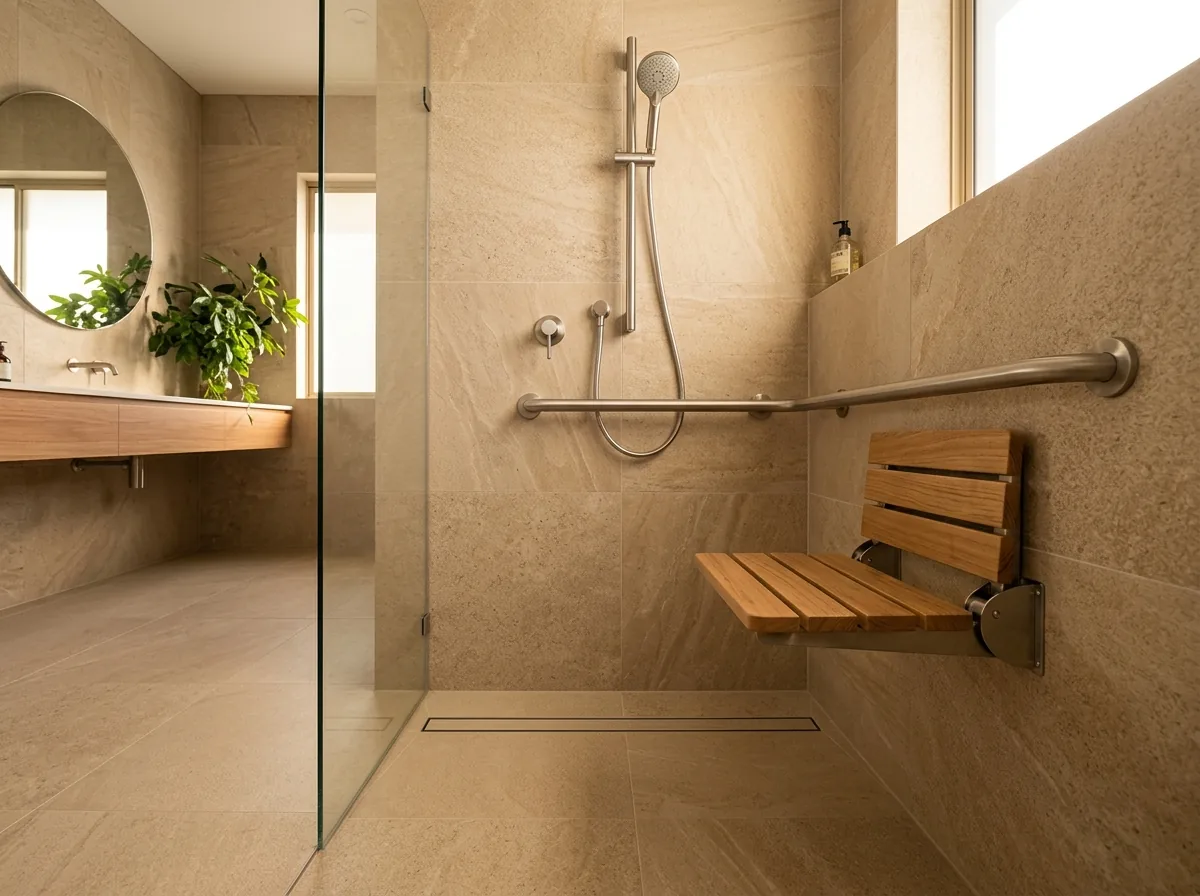
A fold-down shower seat ($380 - $650 installed), a hand-held hose on a riser rail ($280 - $550) and one or two grab rails in the right positions can transform how safe and usable a shower is. These can all be done without structural work if the wall substrate is adequate.
Filed under Bathrooms
Keep reading
Bathrooms · 6 min read
Bathrooms · 7 min read
Costs · 7 min read
Next step
Ask us for a quote. We will tell you what we would change first in your home - and what it costs. AccessAble designs and builds in-house, so there is no waiting on a third party.
Monday to Friday, 7:00am - 5:00pm. Based in Melville, working right across Perth.