
AccessAble Home Modifications

Ageing in place

Ageing in place in Perth: staying in the home you love

Depending on the research paper you read, 65-85% of seniors want to stay in their own home forever. It’s not at all surprising when you consider that our home is our castle. We establish networks of people and places around our homes which take years to build, and are reluctant to let go of. Often it is the home we have raised our children in.

On top of that, the cost of a place in an aged care facility can be truly astronomical. I know of a man in his 90’s whose family recently had to find over $700,000 for a bed in an aged care facility. A nice facility I’m sure, but $700,000 is a lot of money and would fund any home modifications you could require and a lot of care into the future if required. The ongoing fees and exit fees are not included in that total either.

What ageing in place actually means

In one paragraph

Ageing in place means staying in your own home as you get older, rather than moving into a retirement village or residential care. In practice it means modifying your home so it keeps working for you: an accessible and safe bathroom, easy access into the house, wider doorways, safer floors, better lighting. Easier and safer for your long term needs.

A house does not become unliveable all at once. It gets slightly harder every year until one day it stops working for you. At that point it is usually an accident waiting to happen.

Four things it is not

  • It is not a single decision. Most houses get changed in two or three rounds, years apart, as things get harder.
  • It is not only for people already struggling. The work is cheaper and far less disruptive done early.
  • It is not a medical process. Nobody needs a diagnosis or a report to change their own house.
  • It is not all or nothing. For a lot of homes, an accessible bathroom and a couple of ramps is all that’s needed.

Most people do not plan for this. They react to it.

Nearly every call we take starts the same way. There has been a fall, or a parent is being discharged on Thursday and the bathroom is not ready, or showering has quietly turned into a two-person job that nobody wants to talk about.

An event made the decision, not a family. And an emergency is the worst possible moment to be choosing a floor tile, comparing quotes or working out what a fair price looks like.

What we see next is predictable. The scope gets cut to whatever can be finished before the discharge date, the work happens in the wrong order, and some of it gets pulled out and redone properly within a year or two.

The alternative is not clever. It is the same work, brought forward twelve or eighteen months, at a time when nobody is under pressure and you can still be fussy about the tapware.

Getting ahead of it

You choose the scope, the timing and the finish. The work happens around a holiday or a quiet fortnight, you compare two quotes properly, and the house is never unsafe. Nothing about it feels like an emergency, because it is not one.

Reacting to it

There is a discharge date, or a fall that everyone is still shaken by. The scope shrinks to whatever gets someone through the front door by Friday, the choice of trades is whoever has a gap, and half of it gets redone properly a year later.

If you are somewhere in the middle, the $149 home safety audit is the cheapest way to find out which it is going to be.

The real decision

Ageing in place or a retirement village: the honest comparison

We modify homes for a living, so weigh that when you read this. We have also told people to move, more than once, because the house was never going to be the answer for them.

Stay and modify

Best when the house is fundamentally sound and the difficulty is physical, not medical.

A single-storey Perth home on a reasonably flat block is usually easy to make work for the long haul. The bathroom is the big-ticket item, the entry is second, and everything after that is not such a large outlay, other than the kitchen if required.

It works less well if the house is two-storey with the only bathroom upstairs, or if the house is split over several levels or on a major sloping block.
A retirement village

Best when the pull is company, a smaller garden and help on site, not just the building.

Village units are generally bought under a lease or licence rather than as a straight title. There is usually an ongoing service fee while you live there and a deferred management fee deducted when you leave.

That structure is not a reason to avoid it, but it does mean the sticker price is not the cost. Get the contract read by a lawyer who does this regularly before you set the number against a quote to modify your own home.

Residential aged care

Best when the need is care rather than a building problem.

This is usually for people with higher care needs and can be the best solution for some. However, if staying home is your or your loved one’s preference, a home modification and in-home care services can still work for you.

Medical advice and the advice of an occupational therapist would need to be taken into account to make the right decision. We’ll always be honest about what we can do for you. If we don’t believe our services will suit your situation we will be upfront about it.

The trap in this comparison is that the two numbers are not buying the same thing. Modifying buys you a safer version of the house you already own.

Older couple in their Perth home - warm kitchen with good lighting and accessible lever tapware
Good ageing in place work is mostly invisible. Bench heights, lighting and lever tapware, done once, properly.

Room by room

Home modifications for elderly parents: which room comes first

If you only ever do one room, do the bathroom. That is not a sales pitch, it is where the difficulty starts and where a slip and fall does the most damage.

Do this first

The bathroom

Wet floor, hard surfaces, a step to climb over and nothing solid to hold. Everything that makes a bathroom a bathroom also makes it the riskiest room in the house, and it is the room we get called about more than all the others combined.

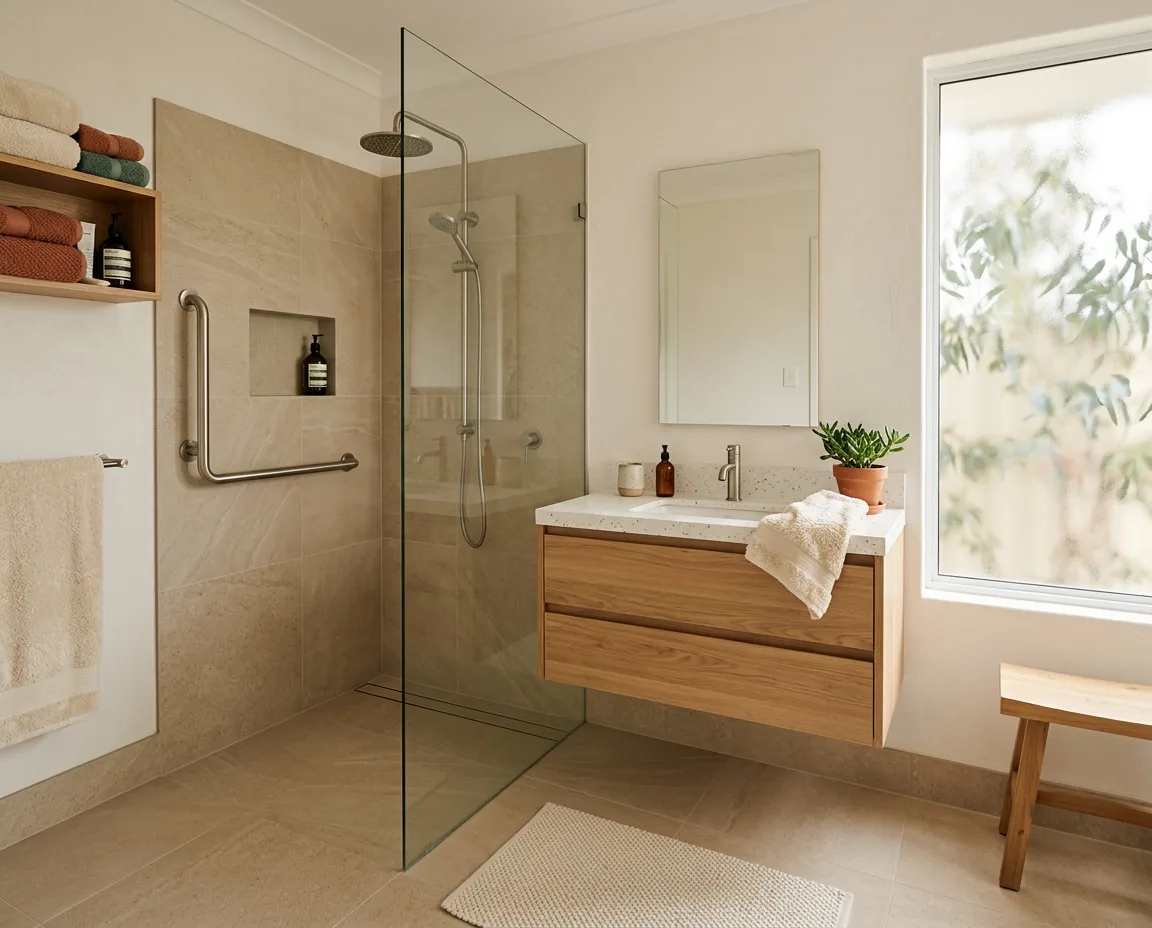
The change that matters most is removing the hob so the shower floor runs flush with the rest of the room. Secondly a non-slip floor tile. A toilet at a height that does not require Olympic level squat strength, and grab rails if required.

Usually second

The way in

Unfortunately, many people struggle to get into their own home. Your home is not really your castle if you can barely get in it. Steps, thresholds, obstacles.

Depending on your requirements a ramp, rail or elevated platform can solve this quite easily and make coming home a relief instead of a danger.

Hard but sometimes necessary

Doorways and hallways

A walking frame needs about 820 mm of clear opening to go through a doorway without a fight. Plenty of Perth homes built between the fifties and the seventies have doorways closer to 750 mm, which is fine right up until the day it is not.

Widening a doorway can be a reasonably big job, and it isn’t cheap. Potentially four or five different trades. But if you can’t get yourself or your walker or wheelchair through it, it just needs to be done. We can also change the door to a slider. Lever handles instead of round knobs are a simple change and make a real difference to arthritic hands.

The minor but still hazardous

Floors and levels

The trip hazards in most homes are not major. A lip at the bathroom door, a step down to a seventies extension, the drop to the back verandah, a rug that has curled at one corner. Each of them was a design decision made for the moment, not the long term.

Ramps, rails, and a non-slip treatment on the wet areas and external steps will rectify most, if not all of it. This is the cheapest and easiest safety work you can do in a house, and can make a huge difference.

When cooking gets tiring

The kitchen

Standing at a bench for forty minutes preparing food is the first sign of difficulty, well before anything else in the kitchen becomes difficult. Then it’s the cupboards you can’t reach into anymore. The potential for burns from the oven and cooktop. The taps you can’t turn.

All of these are very solvable with an accessible kitchen. Easy to access drawers. The right height oven and induction cooktop can reduce burn risk significantly. Lever handle or mixer taps are easy to use for arthritic fingers.

Why we are quicker

One team, so it takes weeks and not months

Most of the businesses you will find when you search for this are therapy or assessment services. They do the report, then hand the building work to a contractor they do not employ. Every hand-off in that chain is a wait.

We design and build with our own people. One quote, one timeline, one crew in the house, and nobody waiting on an external document before a tool comes out of the van.

If you already have an occupational therapist report, bring it and we will build to it. If you do not have one, that is not a problem either, and we are not going to send you off to join a queue for one.

This matters most on a hospital discharge, when the date is fixed and the bathroom is not. AccessAble has been doing accessibility work only for 10+ years, so we already know what is behind most of these walls.

See how the process runs, step by step

When the phone call is urgent

Tell us the discharge date you’re working towards. We will tell you honestly what can be finished by then and what can’t.

Often the sensible answer is a staged one: make the bathroom and the entry usable this week, do the rest over time.

Call 1300 702 287

The hard part

How to raise it with a parent without it turning into a fight

This comes up in almost every enquiry that starts with an adult child rather than the homeowner. None of it is our expertise, exactly. It is just what we have watched work across a lot of kitchen tables.

  1. 01

    Talk about the house, not about them

    The house has a step and a hob. That is a fact about a building, and it is much easier to discuss than whether someone is getting frail. Most of the resistance you hit is about the second conversation, not the first.

  2. 02

    Pick one room and stop there

    A list of eleven changes reads as an eviction notice. One bathroom, quoted, with a start and finish date, reads as a renovation. Get one thing done well and the next conversation happens on its own.

  3. 03

    Start from what they want to keep doing

    The garden, hosting Christmas, having the grandkids stay, walking to the shops. Frame the work as protecting those things and it stops being about decline. It also tells you what to prioritise, which is genuinely useful information.

  4. 04

    Do not lead with the fall

    If there has been one, they already know. Bringing it up as the reason usually produces a defence rather than a decision. Mention it once, gently, and let it sit.

  5. 05

    Bring a number

    Vague worry is easy to dismiss. A written scope with a fixed price against it is a thing you can say yes or no to. That is why we quote before anyone has committed to anything.

  6. 06

    Expect it to take two goes

    Almost nobody says yes the first time. Leave it, come back in a month, and be ready for the answer to have changed on its own. If it is still no, ask what would have to be different for it to be a yes.

What it costs

Ageing in place modifications, and what they run to in Perth

Real ranges for the work we do most. A written fixed price replaces the range once we have measured and looked behind the fixtures.

Accessible bathrooms

An ensuite starts at $12,000 and a family or second bathroom at $15,000. Where you land depends on the size of the room, how much plumbing is involved and how much you want to spend on fixtures and fittings.

$12,000 - $45,000

Wet rooms

An ensuite wet room starts at $15,000 and a family or second bathroom at $18,000. Where you land depends on the size of the room, how much plumbing is involved and how much you want to spend on fixtures and fittings.

$15,000 - $45,000

Accessible kitchens

Benches and cooktops at heights that work seated or standing, with everything you use daily inside easy reach.

$15,000 - $50,000

Access ramps

From a rubber threshold ramp at a doorway through to a weatherproof aluminium ramp outside. Exterior steps are priced per metre.

$200 - $2,000 per doorway

Door widening

Enough width for a walking frame or a wheelchair, finished so the wall does not look patched.

$3,000 - $4,000 per door

Non-slip treatments

A clear coating that changes how the floor behaves wet, without changing how the floor looks.

From $1,000

What moves the number

Three things, mostly. Whether the drainage can stay where it is, what the walls are made of and what is behind them, and how much you want to spend on fixtures and fittings.

Doing several rooms in one visit is cheaper per room than doing them one at a time over five years. That is worth knowing before you decide to stage it, even if staging is still the right call for your budget.

$149

$149 home safety audit

We walk through your home, find the trip and fall risks, and give you a written list of what to fix first. It is the right first step when you know something should be done but not what, or when you want a written list to put in front of the rest of the family.

Book a safety audit

Questions

Questions people ask about ageing in place

What is ageing in place?

Ageing in place means staying in your own home as you get older instead of moving into a retirement village or residential care. It usually involves modifying the house so it keeps working for you, most often a step-free shower, a level entry, wider doorways and better lighting.

I searched aging in place, but you spell it ageing. Are they the same thing?

Yes, they are the same thing. Aging in place is the American spelling and ageing in place is the Australian and British one, and both describe staying in your own home as you get older. We use the Australian spelling because we are a Perth builder, but the searches lead to the same place.

Which room should we modify first?

The bathroom, in almost every case. It is where the daily difficulty shows up first and where a slip does the most damage, so a step-free shower and a properly fixed rail buy you more safety per dollar than anything else. The entry to your home usually comes second.

Is it cheaper to modify the house or move to a retirement village?

Modifying is usually cheaper, but the comparison is not straight. An accessible ensuite starts around $12,000 and a family bathroom around $15,000, and that is a one-off. A village involves an entry price, ongoing service fees and a deferred management fee taken when you leave, so read the contract before you compare.

Do we need an occupational therapist report before you start?

No. If you already have a report we will read it properly and build to it, but we do not require one and we will not send you off to get one first. Waiting for an assessment is the main reason this work stalls for months, and the house is not getting any safer meanwhile.

How long does the work take?

A full bathroom modification takes approximately two to six weeks, depending on whether a custom made shower screen is used. Threshold ramps and non-slip treatment are often a day or two. You get a start date and a finish date in writing before we begin, not a rough idea.

Can we do it in stages?

Yes, and most people do. A common order is the bathroom first, then the entry, then doorways and lighting as they become a nuisance. We will give you a written plan for the whole house and quote the stages separately, so you can do one now and the rest when it suits.

Will the house end up looking like a hospital?

Not if it is specified properly and the budget allows for medium to higher end fixtures, particularly grab rails. If you want a high end finish we can certainly do that. It all comes down to style choices and budget.

Next step

Start with one room and see how it goes

Tell us which part of the house is getting harder and we will come back with a fixed price for fixing it. Call 1300 702 287 or send a quote request. Monday to Friday, 7:00am - 5:00pm.

Get a QuoteCall 1300 702 287

Monday to Friday, 7:00am - 5:00pm. Based in Melville, working right across Perth.