
Living at home · 10 min read
Perth's Ageing In Place, Accessibility Experts - Servicing all of Perth
Living at home
3 June 2026 · 10 min read
AI overview
Ageing in place - staying in your own home rather than moving to supported accommodation - is achievable for most Perth households with the right sequence of modifications. The evidence consistently shows that adapting a home costs far less than moving to residential care, and that people who stay in familiar surroundings maintain independence for longer. The right order is: safety first, then mobility, then daily living - not the reverse.
Key highlights
Summarise with AI
Ask an AI assistant to summarise this article and tell you how AccessAble can help with your home.
Ageing in place means staying in the home you live in now, through the changes that come with getting older, rather than relocating to a retirement village, aged care facility or supported housing. It is what most Australians say they want - and the gap between what people want and what they plan for is the problem that causes crises.
A crisis-driven move often happens fast, under pressure, after a fall or health event. The family is in a hurry, the options are limited, and the person moving has had no say in preparing for it. An ageing-in-place plan prevents that scenario by making the changes when there is time to do them well - before they are urgently needed.
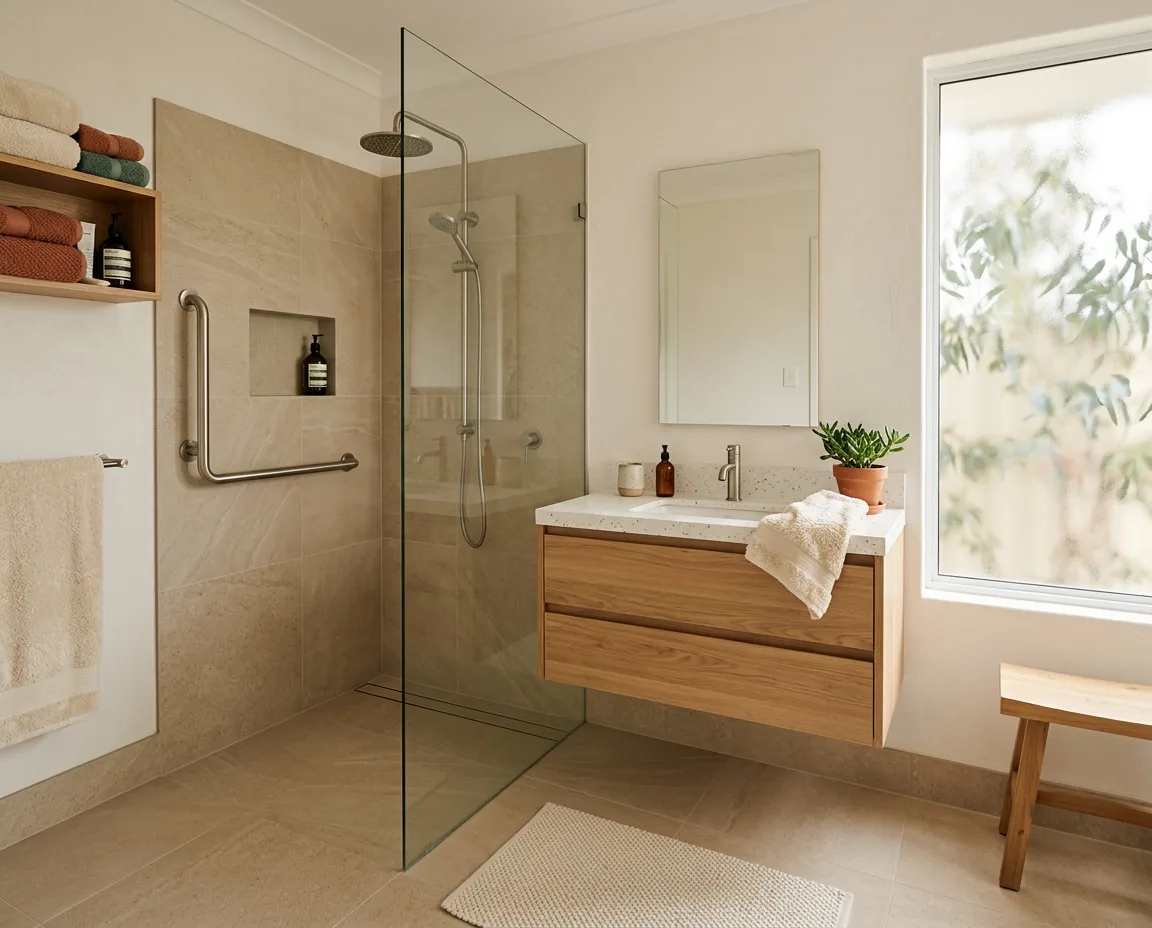
The modifications that allow someone to stay home safely are not dramatic. They are mostly practical: a level-entry shower, grab rails in the bathroom, a handrail on the front steps, lever tapware, good lighting, and a kitchen that is easy to work in from a lower height. These are changes that can be done one at a time, in order of priority, at a pace that suits the household.
A large proportion of Perth's housing stock was built between the 1950s and 1980s - homes with standard bath-and-shower combinations, narrow doorways, timber steps at the front and back, and kitchens that were designed for a person standing at a 900 mm bench with no thought for seated use. Those homes work well for a household with young adults but require modification as mobility changes.
Perth's outdoor lifestyle also shapes the risk profile. A home with a verandah accessed by two steps, a sloped garden, a back shed with a step at the door, and a narrow path between fence and wall presents multiple daily fall risks that a flat, single-level apartment in the city centre does not. Most Perth homes have at least three or four changes that would meaningfully reduce fall risk.
The heat also matters. Perth's summers are extreme, and heat affects balance and coordination even in healthy adults. Someone who is managing well in autumn can become more fall-prone in January when the heat increases fatigue and dehydration. Modifications that reduce the effort required in daily tasks - a grab rail that takes the strain off standing up - have a larger benefit in a hot climate than they might elsewhere.
The most common mistake in home modification planning is starting with what is most visible - replacing the kitchen, repainting, updating light fittings - while leaving the bathroom and the steps unchanged. The bathroom is where the highest-risk falls happen, and it should be the first priority.
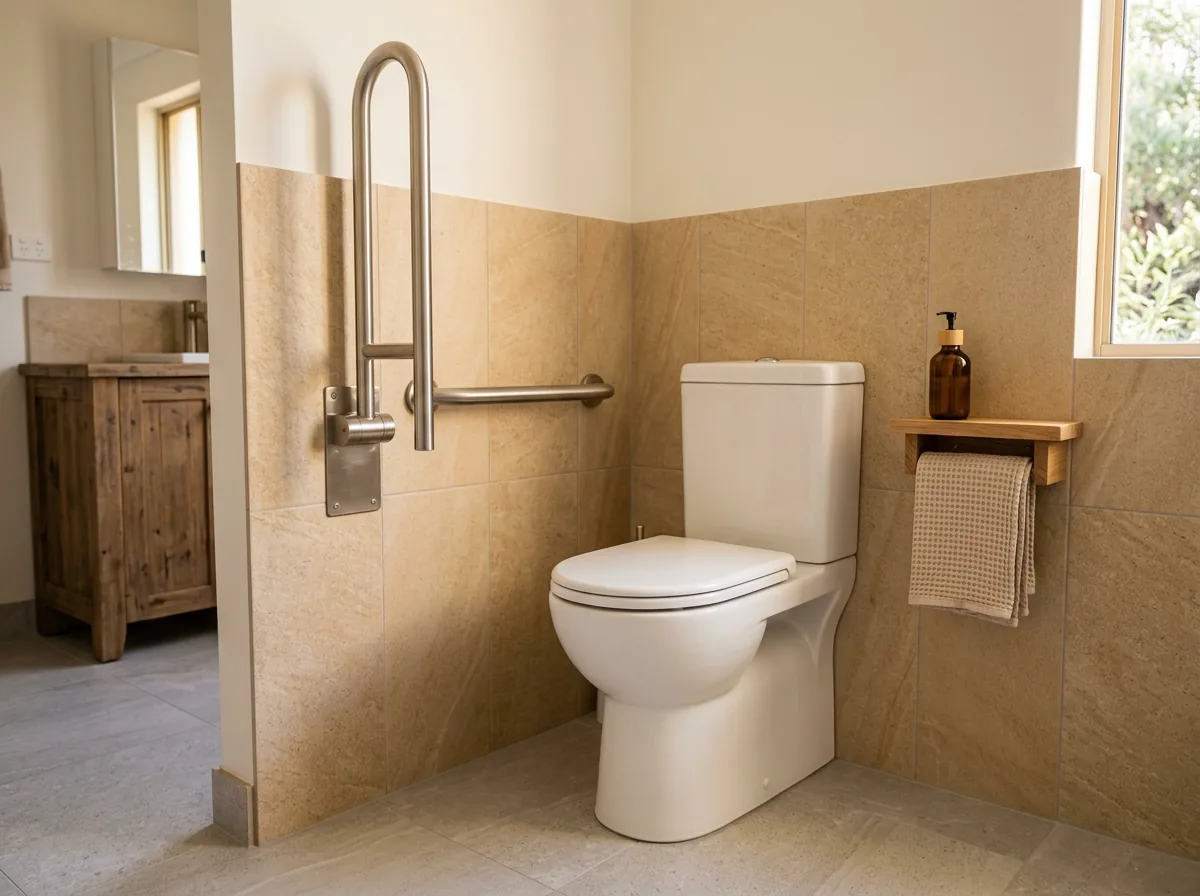
Start with fall prevention: grab rails in the shower and beside the toilet, a handrail on the external steps, and non-slip flooring in the bathroom. These changes are relatively low cost ($800 - $2,000 for a basic set) and have an immediate effect on daily risk. They can be done in a single visit without disrupting the household significantly.
After fall prevention, address access: the shower hob (if it exists), the doorway widths, and any steps that restrict movement through the home. These are more expensive - a shower conversion starts at $12,000 - but they extend the range of activities that can be done independently and delay the point at which assistance is needed. Access modifications are worth prioritising before strength or balance decline to the point where using the shower becomes difficult.
A comprehensive set of home modifications to support ageing in place - stages one through five - typically costs $15,000 - $45,000 in Perth, depending on the starting condition of the home and the scope of changes needed. That sounds significant, and it is. But it helps to compare it to the alternative.
Residential aged care in Perth costs $50,000 - $130,000 per year in accommodation and care fees, depending on the facility and level of care required. A home that enables someone to live independently for an additional two or three years represents a saving of $100,000 - $300,000 compared to moving into care at the point the unmodified home became unsafe.
The savings are not only financial. Staying at home - in the suburb you know, near the people and routines you value - is consistently associated with better mental health outcomes and maintained independence. The modifications pay for themselves in ways that are hard to put a dollar figure on.
The trigger for most home modification conversations is a fall, a near-miss, or a diagnosis. That is not the worst time to act, but it is not the best time either. After a fall, the household is anxious, the person who has fallen may be in hospital or rehabilitation, and decisions are made in a hurry with limited information.
A home safety audit - a systematic room-by-room assessment of fall risks and access barriers - done while the household is stable gives a clear picture of what changes are needed and in what order. AccessAble offers a $149 home safety audit that covers the whole house. The audit produces a written report identifying every risk and recommending modifications in priority order.
That report becomes the plan. Modifications can then be scheduled at a pace that suits the household - spreading the cost over one, two or three years, doing the highest-priority items first. This approach avoids the rushed, expensive, incomplete modifications that tend to happen after a crisis.
The most cost-effective ageing-in-place plan builds in what the home will need over the next five to ten years, not just what it needs today. A shower conversion done today that includes solid wall blocking for future rails costs almost nothing extra. A doorway widened to 820 mm when other renovation work is happening costs far less than widening it separately later.
A useful question to ask when planning any modification is: 'If mobility becomes more limited in five years, will this still work?' A fold-down shower seat fitted today is useful occasionally now and essential later. A lever tap fitted now is convenient now and necessary later. Planning for five years out, rather than six months out, tends to produce better decisions.
The home should also be thought of as a whole rather than room by room. A bathroom that is fully accessible but reached only via a narrow corridor with a step at the entrance does not function as an accessible bathroom. The circulation path through the house - from the bedroom to the bathroom, from the kitchen to the living area, and from the front door to the car - needs to be assessed as a continuous route.
Decisions about home modification often involve family members who do not live in the home - adult children who are concerned about a parent, a carer who comes in regularly, a partner who is managing the household with the person. Getting those perspectives into the conversation early produces better outcomes than a plan made in isolation.
The most useful family conversations happen before a crisis, not during one. A shared understanding of what the home needs, what the priority order is, and who is responsible for organising each stage avoids the disagreement and delay that tend to happen when a decision is forced by circumstance.
A quote from AccessAble can be sent to family members wherever they are, including interstate. The written audit report and modification plan can be shared with everyone involved, so the conversation is based on specific recommendations rather than general anxiety.
Related services
Ageing in place means staying in your own home as you get older, rather than moving to a retirement village or aged care facility. It typically involves modifying the home to reduce fall risk and maintain independence - changing bathrooms, adding rails, improving access - before those changes become urgently needed.
The highest-priority modifications are grab rails in the bathroom and on external steps (fall prevention), followed by a level-entry shower (access), then wider doorways if a mobility aid is needed. Kitchen modifications and external ramps come after those. The sequence matters - safety first, then access, then daily living.
A comprehensive set of modifications - bathroom, external steps, kitchen and doorways - costs $15,000 - $45,000 in Perth, spread over several stages. Individual modifications start from $800 - $2,000 for a basic fall-prevention set. Compared to residential aged care at $50,000 - $130,000 per year, home modification is very good value.
Before a fall or health event - while there is time to plan, compare options, and spread the cost. A home safety audit done while the household is stable produces a clear priority list. Modifications done in stages over one to three years are far less disruptive and less expensive than modifications done in a hurry after a crisis.
Not necessarily. A home with stairs can often be made workable with a handrail on both sides, a stairlift, or by ensuring that all the daily living essentials - bedroom, bathroom, kitchen - are on the ground floor. Moving is not the only option; whether it is the best option depends on the specific layout and the person's situation.
A home safety audit is a room-by-room assessment of fall risks and access barriers in the home, carried out by a qualified assessor. It produces a written report identifying every risk and recommending modifications in priority order. AccessAble offers a $149 home safety audit covering the whole house.
Filed under Living at home
Keep reading
Living at home · 10 min read
Access & mobility · 9 min read
Access & mobility · 6 min read
Next step
Ask us for a quote. We will tell you what we would change first in your home - and what it costs. AccessAble designs and builds in-house, so there is no waiting on a third party.
Monday to Friday, 7:00am - 5:00pm. Based in Melville, working right across Perth.